By, Big Boss.
With OYO STATE being the centre of the Old Oyo empire, exhibiting the culture and tradition of the Oyo descendants, there are some values that have been sustained till now and are what make some parts of the state maintain their significance.
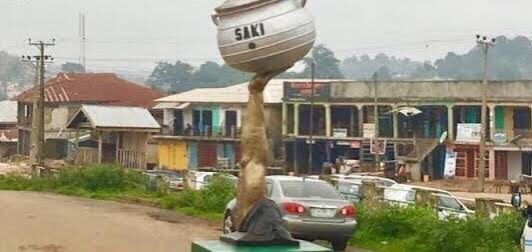
One such part of Oyo State is SAKI. Saki is a town in Oyo, and it is located about 40 miles from the Benin border, close to the source of the Ofiki River, which is the main tributary of the Ogun River. After Old Oyo, located 70 miles to the east-northeast, was destroyed by Muslim Fulani conquerors in 1835, Saki, which was formerly a part of the Oyo kingdom, became a Yoruba refugee camp. However, the Yoruba Mission at the time had built an Anglican church in the town by the early 1860s.
As a result of its agricultural operations, Saki is known as the “food basket” of Oyo State. Also, the local government authority for Saki West has its headquarters there. Saki is often referred to as the heart of Ogun and one of the ancient towns in Yorubaland.
HISTORY
According to certain historians, Ogun, the eldest son of Oduduwa, created Saki, which explains why it was formerly known as Ile Ogun. As a result of a religious crisis, which is the historical fact underlying this, Oduduwa’s father and his followers went to the Niger region of Bussau from Egypt. While travelling, Ogun learned that Saki was a small village that resembled a hunter’s camp. He left Saki and traveled to Ibarapa, Lagos, Benin, and Ife, and then returned to Saki.
Temporarily serving as the capital of the Yoruba kingdom was Saki, the governing town of Ogun. He passed away in Saki, the first village in Ogun. This is the reason why people frequently state that Ogun is an Ire stranger but a Saki native.
History has it that the name of the town was called “Sa-kiri,” which means “a fleeing refugee.” According to accounts, the escaping refugees eventually found relief on Asabari Hill in the town. As a result, a Saki native’s “oriki” (eulogy) is incomplete without the designation “Omo Asabari,” or “Son of Asabari.” Other historians who believed that Okekesi’s personal relationship with his brother Oranmiyan—the first Alaafin of Oyo—was what caused the name to change from Ile Ogun to Saki, agreed with this. According to history, Okekesi had a fight with his cousin brother Oranmiyan over a lady and left Oyo Ile shortly after it was built for Ile Ogun.
However, Okekesi had been asked to go back to Oyo Ile three times by Oranmiyan, but he refused each time. According to a quotation from Oranmiyan, “O nsa kiri ni” implies “he has always been on the run.” As a result, it was claimed that Saki originated from this phrase. After the Muslim Fulani conquerors destroyed the Old Oyo in 1835, Saki, which was formerly a part of the old Oyo Empire, became a Yoruba refugee town. According to people who are unfamiliar with its past, Saki holds a significant position among Yoruba towns.
Years later, the first Saki king, according to legend, was Akinbekun. He was Oranmiyan’s son, born to him by Egilolo, who was the daughter of Kisra, the king of Ibadan. So, because River-Ogun emerged as a result of disputes between the Okere and his wife, Modelewu, the reign of Akinbekun as king of Saki was associated with a highly significant event. It was rumoured that Akinbekun used to wear a power garment when engaged in combat.
Modelewu would pray for him once he put on the garment, and he would triumph in combat. However, there was a requirement that the clothing not be damaged by rain or touched by a woman. Akinbekun had dried his garment outside because it was a scorching day, but he wasn’t home at the time. The situation changed, and rain started to fall.
He received prompt assistance from Modelewu, who has a wonderful heart, and he quickly returned home. Modelewu, who had a large breast, detested it when it was mocked. When the king returned, he chastised and mocked her for her large breasts. She eventually left the community as a result of this, and she later became the river Ogun close to Iseyin. History states that ever since that time, it has been illegal for any Saki governing Okere to look at the river when traveling through it. The town’s traditional leader is known as the Okere of Saki.
Oba Kilani Olatoyese Ilufemiloye Olarinre, who passed away on Friday, April 5, 2013, two days before the first anniversary of his coronation, was replaced as Okere of Saki on December 18th, 2019, by Oba Khalid Olabisi Oyeniyi. An Anglican church was also built in the town by the Yoruba Mission at the beginning of the 1860s.
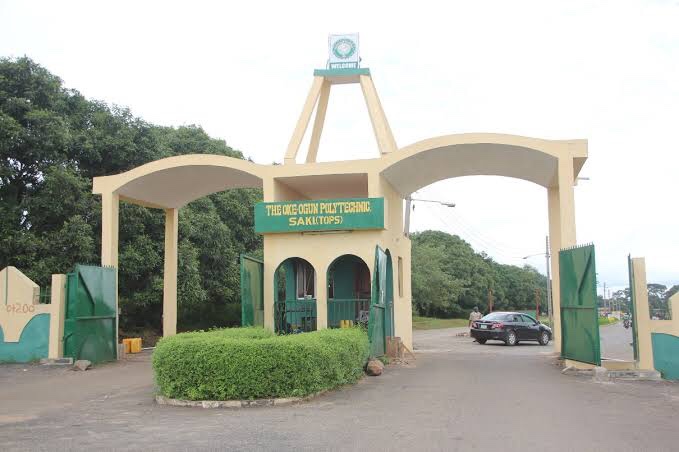
Today, Saki has expanded to include institutions such as Oke-Ogun Polytechnic, The Kings Poly, Muslim Hospital’s School of Basic Midwifery, Baptist Medical Center’s School of Nursing and Midwifery, and Saki’s School of Laboratory, among other’s.
NATURAL RESOURCES
The resources of the region, shows that the area is richer than some African countries, including Botswana which is rich in diamond and is one of the most prosperous African countries.
In solid minerals, Oke Ogun has no equal in Nigeria. In almost all sectors of agriculture, the region is beyond compare.
Marble, dolomite and others are in Igbetti, Olorunsogo Local Government and in Oriire. Tourmaline is in Komu, Itesiwaju, Tantalite in Sepeteri, Quartz in Itesiwaju, Columbite, talc and several other minerals in all parts of the region. Indeed, the economic development of Oyo State can be taken for granted on account of the mineral deposits in Oke Ogun.
TOURISM
On tourism, that same region is blessed with almost too much. There is the Ado Awaye suspended lake, Igbo Oba in Kisi, Ebedi Hill in Iseyin, Asabari Hill in Saki, Akomare Hill in Igangan and many other natural tourist attractions waiting to be developed. The Ikere Gorge Dam, which has the capacity to boost the agro-industrial development of the whole of Nigeria as well as supply power to the people has been abandoned for years.
Oke-Ogun not only has the land and mineral resources, it has a hardworking, honest people to whom integrity and humility are second nature.


















 Press Council The Oke-Ogun Polytechnic,Saki (TOPS)